
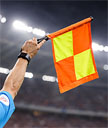
What is offside
Football is a game of simple rules, but there is one rule that has sparked more debates, arguments and analyses than any other for decades. That is, of course, offside. The question of what offside is often confuses newcomers to football, as well as long-time fans and players who enjoy betting on football when faced with complex situations involving millimeter decisions or influence on the game without touching the ball.
Understanding offside is not just about knowing the rules of football; it is key to understanding tactics, attackers’ movements and defensive discipline. In this article, we will demystify this rule—from its basic principles to the technological revolution brought by VAR—and explain why offside, despite its controversies, is an essential "guardian of the spirit of the game".

Basic definition: rule 11
Simply put, offside is a rule designed to prevent attackers from “camping” in front of the opponent’s goal, waiting for the ball without participating in the rest of the game.
According to official rules, a player is in an offside position if two conditions are met at the moment a teammate plays the ball:
They are on the opponent’s half of the ptich.
They are closer to the opponent’s goal line than both the ball and the second-to-last opponent (the last is usually the goalkeeper, so in practice the position relative to the last defender is considered).
However, being in an offside position is not a foul by itself. The referee will stop the match only if the player becomes active in the play. This is a key distinction that often confuses bettors. A player can stand offside on one side of the pitch, but if the ball goes to the other side to another player who is not offside, the match continues.
When does an offside position become an offense?
For the referee to raise the flag (or for VAR to intervene), a player in an offside position must somehow influence the match at the moment the ball is played by their teammate. There are three main ways this happens:
1. Influence on the game
This is the most common scenario. A player in offside receives the ball or touches it after a teammate passes it. As soon as they touch the ball, the offense is committed and an indirect free kick is awarded to the opposing team.
2. Influence on an opponent
This is a gray area that causes the most controversy. A player does not need to touch the ball to be offside. A foul is called if the player, through their movement or position:
Blocks the goalkeeper’s line of sight (e.g., stands directly in front of them while a teammate shoots)
Interferes with an opponent trying to reach the ball
Makes an obvious run toward the ball that confuses a defender
3. Gaining an advantage
This applies to situations where the ball rebounds off the post, crossbar or goalkeeper (a deflection) and reaches a player who was in an offside position when the original shot or pass was made. Even if they didn’t touch the ball at first, they gained an advantage from their illegal position.
Body parts that count
A common question is: what if only the hand is offside? The rules are clear—head, body, or legs count in offside. Hands and arms do not. This includes shoulders down to the bottom of the armpits, which are now considered legal playing parts and therefore included in the offside calculation.
In the era of VAR technology, this rule is applied down to the smallest detail and we’ve witnessed offsides called for the tip of a boot or a knee.
Exceptions: when there is no offside
There are specific situations in which the offside rule does not apply, even if a player is behind the defense. Knowing these exceptions separates experts from ordinary spectators.
No offside occurs if the player receives the ball directly from:
Goal kick: when the goalkeeper plays from the penalty area.
Throw-in: when the ball is thrown in by hand from the sideline. This is tactically important, as attackers can stand deep behind the defense.
Corner kick: a ball played from the corner does not count as offside.
Also, offside does not apply if the player is on their own half when the pass is made. That’s why we often see fast attackers starting from their own half at the moment of a pass, even if there is no one in front except the goalkeeper.
Another important detail: if the ball is intentionally played by an opponent (e.g., a backward pass), an attacker in an offside position has the right to play the ball and score. This is not considered offside because the ball did not come from a teammate.
Evolution of the rule and tactical significance
Offside has not always looked like this. In the early days of football (mid-19th century), any forward pass was forbidden (similar to rugby). Later, the rule evolved: three players between the attacker and goal were required, and in 1925 this was reduced to two (goalkeeper + one defender), drastically increasing the number of goals. Today’s rule, giving an advantage to an attacker in line with the second-to-last defender, was introduced in 1990.
Offside trap
This rule gave rise to one of the most sophisticated defensive tactics: the offside trap. Defenders move forward in unison at the moment a midfielder sends a pass, leaving attackers “caught” behind them. This is a high-risk, high-reward tactic. If successful, the attack is stopped. If one defender is late, the opponent breaks free toward the goalkeeper. Teams with high defensive lines must have perfect coordination for this to work.
Technological Revolution: VAR and semi-automatic offside
The introduction of video technology (VAR) has changed how we experience offside and the dynamics of live betting. There is no longer “referee discretion” in offside calls—it’s now a factual decision: either it is offside or it isn’t.
However, drawing lines on the screen and waiting several minutes slowed the game. That’s why semi-automatic offside technology was introduced. This system uses cameras tracking 29 points on each player’s body 50 times per second, along with a sensor in the ball. When a questionable situation occurs, the system automatically generates a 3D animation and notifies the VAR room within seconds. This makes decisions faster and more precise, minimizing human error.
Still, debates about “passive offside” and influence on the game remain, where the referee must watch the screen and make a subjective judgment about whether the player interfered with the goalkeeper.
Conclusion: offside as a guardian of fair play
Although it often frustrates fans by interrupting the joy of a goal, offside is a rule that makes football tactically deep and dynamic. Without it, the game would be reduced to long balls toward attackers standing next to the goalkeeper and the midfield would lose its significance.
In the end, offside forces attackers to be quick and intelligent and defenders to be organized and disciplined. In the tension between the defensive line and the attacker’s sprint lies much of the beauty of the “world’s most important side thing.”

A born enthusiast. Looking forward to a new day and new opportunities to learn. Enjoying in conversations with other people and understanding their emotions, always ready to be a good listener. Able to display a whole lot of positive emotions and pass it to other people. Not having problems with talking in front of the group and keeping their attention. Careful with keeping promises and looking at life with internal locus of control.