

American Football for beginners: rules, points and positions
American football is a sport that at first glance can look like a chaotic clash of armored giants. For the average European viewer, used to the fluidity of “regular” football (called soccer in the U.S.) or basketball, American football, with its frequent stops, numerous lines on the field, and specific terminology, can be confusing.
However, beneath this rough exterior lies one of the most tactically sophisticated sports in the world. It is often described as “chess with living pieces,” where every play, every step, and every block has a precise place in the strategy—a fact well known to fans of betting on this sport. The popularity of the NFL and the spectacle of the Super Bowl is slowly reaching our region, making it the perfect time to demystify American football and explain the basics of this fascinating game.
This guide is intended for absolute beginners and for those who want to understand what is really happening on the field when commentators shout “Touchdown!”
The basic goal of the game
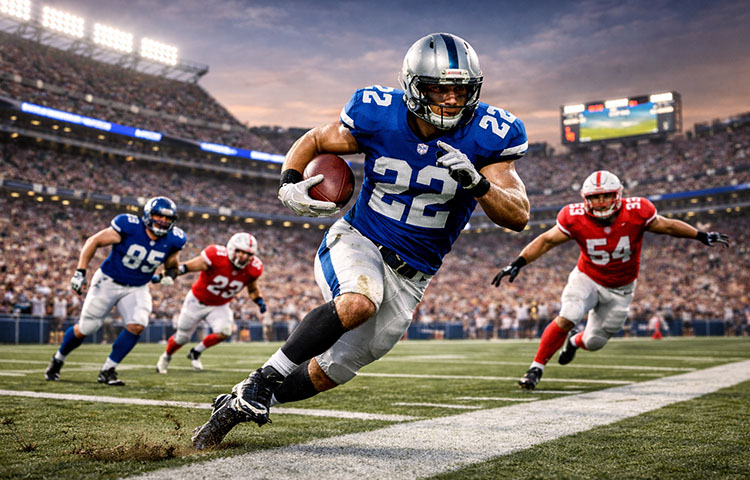
The objective is simple: move the ball into the opponent’s end zone at the far end of the field and score points. The team with the most points at the end of the game wins.
The field is 100 yards long (plus two 10-yard end zones) and about 53 yards wide. It is marked with lines every 5 yards to help players and referees measure the progress of the offense.
How offense works: the down system
This is a concept that often confuses beginners but is the core of American football. When a team has the ball (offense), it has four attempts (downs) to gain at least 10 yards.
First down (1st & 10): The offense starts at the line where the ball is placed. They have four attempts to move 10 yards.
Progress: If they gain, for example, 4 yards on the first attempt, the next play is called 2nd & 6 (second attempt, 6 yards remaining).
Resetting: If the team gains all 10 yards (in one or more plays), they earn a new first down and another four attempts for the next 10 yards.
The goal is to gain ground step by step and move closer to the opponent’s goal.
What if they fail? If the offense uses three attempts and doesn’t gain 10 yards, they usually do one of two things on the fourth down:
Punt: Kick the ball as far as possible from their own goal to make it harder for the opponent to start their drive.
Field goal: If close enough, kick the ball through the goalposts for 3 points.
If they attempt the fourth down and fail, the opponent gains possession at that exact spot, which is very risky.
Scoring methods
There are several ways to score in American football:
1. Touchdown – 6 Points
This is the “holy grail” of offense. It is scored when a player runs into the opponent’s end zone or catches a pass in it. After a touchdown, the team has the opportunity for additional points (PAT – Point After Touchdown):
Extra point (1 point): Kick through the goalposts from a short distance (most common).
Two-point conversion (2 points): Attempt to enter the end zone again in one play from the 2-yard line (riskier, but worth more).
2. Field Goal – 3 Points
If the offense cannot reach the end zone but is close enough (usually within 35–40 yards), the kicker attempts to kick the ball through the Y-shaped goalposts.
3. Safety – 2 Points
This is the only way the defense can score directly (other than intercepting and running it back for a touchdown). It happens when a defensive player tackles an opponent with the ball in their own end zone.
Teams and positions: three units in one
A unique feature of American football is that the same players do not play both offense and defense. Each team has three specialized units of 11 players:
1. Offense
Their job is to gain yards and score points.
Quarterback (QB): The most important player. The “brain” of the team, receives the ball at the start of each play, and decides whether to pass, hand off or run.
Offensive line: Five large players who protect the quarterback and open paths for runners.
Wide receivers and running backs: Players responsible for gaining yards with speed and agility.
2. Defense
Their goal is to stop the opponent, tackle the player with the ball, or take the ball away.
Defensive line: Try to break through protection and tackle the quarterback (sack).
Linebackers: Versatile players who defend both runs and passes.
Defensive backs: Fast players who cover opposing receivers.
3. Special teams
They enter the field only during kicks (kickoff, punt, field goal). They often decide games in tight finishes.
Game duration and the clock
A game is officially 60 minutes long, divided into four 15-minute quarters. However, an average NFL game lasts about 3 hours.
Why? Because the clock often stops:
When a pass is incomplete
When a player goes out of bounds
After scoring plays
During timeouts and penalties
There is a halftime between the second and third quarters, similar to regular soccer.
Yellow flag: penalties
When a referee throws a yellow flag onto the field, it indicates a penalty. The referee then explains the infraction to the stadium. Penalties in American football are measured in yards, not cards. If the offense commits a foul, they move backward (e.g., 10 yards). If the defense commits a foul, the offense gains yards or an automatic first down.
Common fouls include:
Holding: Grabbing an opponent with hands (illegal except for the ball carrier).
False start: Offense player moves before the play begins.
Pass interference: Preventing a receiver from catching the ball before it arrives.
Why watch american football?
American football is the pinnacle of strategy and athleticism. Every play is a small battle. Coaches spend days analyzing opponents to call the perfect play to fool the defense.
On one side, you have the raw power of the linemen pushing in the trench. On the other, you have the incredible precision of the quarterback, throwing the ball 50 yards to a teammate sprinting full speed while pursued by defenders—a moment of thrill for fans, especially those who enjoy live betting.
Once you understand the basics - what a down is, how much a touchdown is worth, and who does what on the field- American football stops being chaos and becomes one of the most exciting sporting spectacles in the world.

A born enthusiast. Looking forward to a new day and new opportunities to learn. Enjoying in conversations with other people and understanding their emotions, always ready to be a good listener. Able to display a whole lot of positive emotions and pass it to other people. Not having problems with talking in front of the group and keeping their attention. Careful with keeping promises and looking at life with internal locus of control.