

Snooker rules at a glance: scoring, fouls and “foul & miss”
When you enter a darkened hall where the only light is focused on the green surface of a massive table, and the silence is so deep that you can hear nothing but the sound of the cue striking the ball, you know you are in the world of snooker. Unlike billiards ("pool"), which is often played in noisy bars over a beer, snooker is a sport of elegance, bow ties, and iron discipline.
Many spectators and even passionate sports betting fans, often confuse snooker with regular billiards. Although they may look similar, the differences are drastic - from the size of the table and the number of balls to the complexity of the rules. Understanding snooker rules is essential not only for enjoying the brilliance of Ronnie O'Sullivan or Judd Trump, but also for recognising the key moments that decide a match.
In this article, we will demystify this beautiful game, explain how scoring works, what "foul and a miss" means, and why defence is just as important as attack.

The playing area: table and balls
The first thing you notice about snooker is the size of the table. The dimensions are impressive - approximately 3.6 metres long and 1.8 metres wide (12 feet x 6 feet). The pockets are significantly narrower than on a pool table, and the cushions are rounded, meaning the ball must be struck with great precision to go in.
There are 22 balls on the table:
- White ball: the only ball the player is allowed to strike with the cue.
- 15 red balls: Each is worth 1 point.
- 6 coloured balls: Yellow (2 points), Green (3 points), Brown (4 points), Blue (5 points), Pink (6 points), Black (7 points)
The goal of the game and frame flow
A snooker match consists of "frames" (individual games). The objective of each frame is to score more points than your opponent by potting balls in a specific order.
The basic cycle: As long as there are red balls on the table, the player must first aim for and pot a red ball.
- If the player pots a red ball (worth 1 point), the next shot must target one of the coloured balls (chosen by the player).
- If a coloured ball is potted, the player receives its point value, and that ball is returned to its designated spot on the table (respotted).
- The player then targets another red ball.
This cycle (Red -> Coloured -> Red -> Coloured) continues until all red balls are potted.
Final phase: Once there are no more red balls left on the table (and after the final coloured ball following the last red has been potted), the coloured balls must be potted in strict order of value: Yellow -> Green -> Brown -> Blue -> Pink -> Black. In this phase, once a coloured ball is potted, it stays in the pocket and is not returned to the table.
Fouls and penalties: when does the opponent receive points?
In snooker, you do not score points only through your own shots, but also through your opponent’s mistakes. The minimum penalty for a foul is 4 points, but it can be higher (5, 6, or 7), depending on the value of the ball involved in the foul.
The most common fouls are:
- Potting the white ball (Scratch).
- Failing to hit any ball.
- Hitting the wrong ball first: If the player is supposed to target a red ball but hits the blue first, it is a foul.
- Touching a ball with a hand or clothing.
If a player commits a foul while targeting the blue ball (5 points), the opponent receives 5 points. If the foul involves the black ball (7 points), the opponent receives 7 points. If the foul involves a red ball, the penalty is the minimum 4 points.
The "Foul and a Miss" rule
This is the rule that often confuses beginners. If a player fails to hit the target ball and the referee believes the ball could reasonably have been hit (meaning the angle was not impossible), a "Foul and a Miss" is called. The opponent then has the option to:
- Accept the table position and continue playing.
- Force the player who made the mistake to replay the shot from the same position (the referee restores the balls to their previous spots). This can happen multiple times, resulting in a significant loss of points for the player who cannot escape the difficult situation.
Defence: the art of "snookering"
The name of the game comes from the situation where you place your opponent in a position where they cannot hit the target ball directly because another ball blocks the path. In this case, the opponent is said to be "snookered".
The opponent must then use the cushions (table rails) to reach the target, which is extremely risky and often leads to a foul. A good defensive shot ("Safety shot") is just as important as potting a ball. You will often see players deliberately avoid attempting a difficult pot and instead gently send the white ball to the other end of the table, leaving the opponent in an almost impossible position. It is a tactical battle of patience and endurance.
Free Ball
If your opponent commits a foul and leaves you "snookered" (unable to see both sides of any legal target ball), the referee calls a "Free Ball". You may then nominate any coloured ball to act as a red ball. For example, you can target the brown ball, pot it, receive 1 point (as if it were a red ball), and then continue normally by targeting a coloured ball.
Maximum break (147)
The holy grail of snooker is the "Maximum Break". This happens when a player pots all 15 red balls in a single visit to the table, combining each red with the black ball every time (15 x 1 + 15 x 7 = 120 points), and then pots all coloured balls in order (27 points). The total score is 147. This achievement is equivalent to a "perfect game" in bowling or a "hole-in-one" in golf.
Winning a frame and a match
A frame ends when:
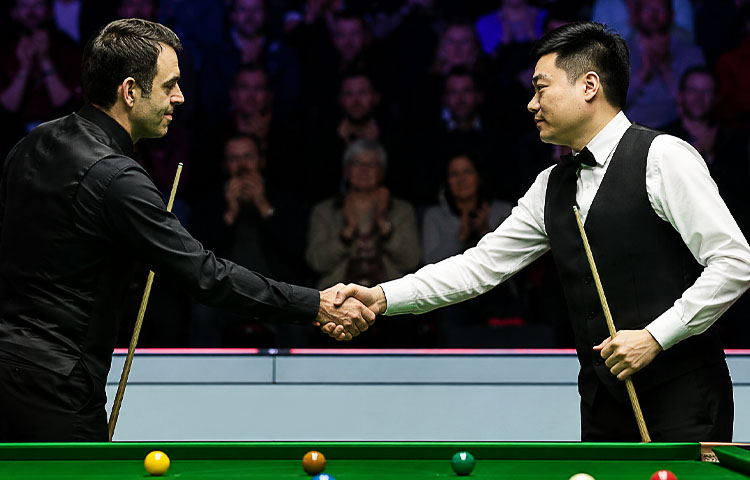
- One player has more points than remain available on the table, and the opponent decides the difference cannot be recovered even through forcing fouls via snookers. The opponent then "offers a handshake" and concedes the frame.
- The black ball is potted at the end (or a foul is committed on the black).
Matches are played over a set number of frames. In smaller tournaments, this may be "Best of 7" (first to 4), while the World Championship final is played as a true marathon - "Best of 35" (lasting two days).
Conclusion
Snooker is a sport that does not forgive impatience. One poor contact, one millimetre of error in positioning the white ball can cost you a frame, or even the entire match. For viewers and those who enjoy live betting, understanding snooker rules opens a completely new dimension of enjoyment. It is not only about who pots better, but who thinks three shots ahead, who controls their nerves better, and who knows when to attack and when to retreat and hide the white ball behind the yellow.

A born enthusiast. Looking forward to a new day and new opportunities to learn. Enjoying in conversations with other people and understanding their emotions, always ready to be a good listener. Able to display a whole lott of positive emotions and pass it to other people. Not having problems with talking in front of the group and keeping their attention. Careful with keeping promises and looking at life with internal locus of control.