
What are the basic rules and positions in handball?
Handball is a sport built on raw power, blazing speed, and tactical brilliance. On a 40x20 meter court, two teams battle in constant transitions between defense and attack, where every move, pass, and shot can change the course of the match.
For someone watching it for the first time, handball may seem like controlled chaos. However, beneath that dynamic surface lies a precisely structured system of rules and player roles. Understanding the fundamental principles of the game and the responsibilities each player carries is key not only for fully enjoying the skills on display, but also for anyone who wants to analyze matches or possibly place handball bets.
Knowing what the pivot does, and what the center back does, opens up a whole new level of understanding.
Basic handball rules
The 3 steps and 3 seconds rule
A player holding the ball may take up to three steps before dribbling or passing. They may also hold the ball for no more than three seconds. These rules enforce fast-paced play and constant movement.
Goalkeeper area
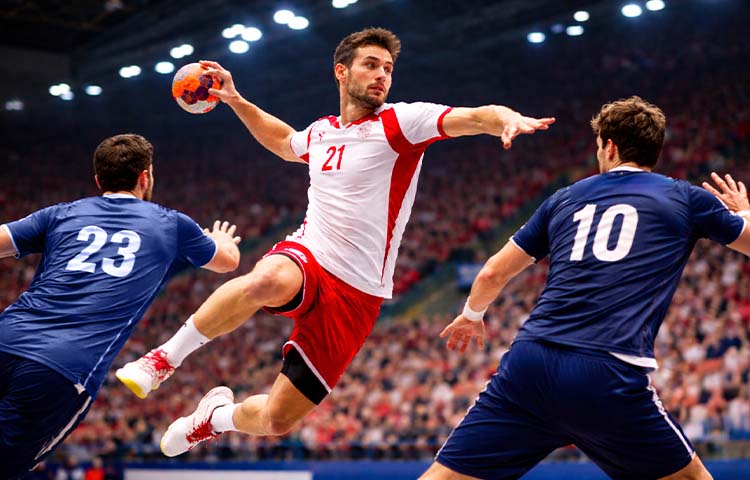
The six-meter line marks the “sacred goalkeeper zone” where only the goalkeeper is allowed. Attackers can jump into the area to shoot, but the ball must leave their hand before they land. Stepping on the line results in a foul.
Dribbling
Similar to basketball, players can dribble the ball. However, if a player stops dribbling and holds the ball with both hands, they cannot dribble again—they must pass or shoot.
Passive play
Referees can penalize a team if it shows no intent to attack. Once passive play is signaled, the team has only a few passes left to finish the attack, preventing time-wasting.
Sanctions
Rough play is strictly sanctioned. Minor fouls result in a yellow card, more serious ones in a two-minute suspension. A red card means the player is excluded for the rest of the match.
Team Structure: Handball positions
Each team has seven players on the court: six field players and one goalkeeper. Every position requires specific physical and technical strengths.
Goalkeeper
The goalkeeper’s role goes far beyond stopping shots. As the only player allowed to use their legs for defense within the goal area, the goalkeeper is often the key figure of the team. A strong goalkeeper not only blocks clear chances but also launches fast breaks with long, precise passes to teammates in transition—usually the wings.
Center back
If the goalkeeper is the heart of the defense, the center back is the brain of the attack. They organize play, set offensive patterns, identify gaps in the defense, and deliver timely passes. This role demands intelligence, game vision, precision, and instant decision-making. Top center backs elevate the entire team.
Left and right back
Positioned on both sides of the center back, backs are primarily responsible for long-range shooting, often from nine meters or more. They are typically the tallest and strongest players, capable of rising above defenders to unleash powerful shots. In addition to shooting strength, they must work closely with the pivot and wings.
Key attributes of a top back:
Height and strong vertical leap
Powerful, accurate shot
Ability to beat defenders 1-on-1
Good cooperation with the pivot
Wings (Left and Right)
Wings are the fastest and most agile players. Positioned near the sideline, their speed is crucial for fast breaks. In set attacks, they score from tight angles, often jumping into the goal area to secure a better shooting position. Their role requires technique, explosiveness, and precision.
Pivot
The pivot is perhaps the most physically demanding position. Operating on the six-meter line, the pivot constantly battles defenders. Their tasks include receiving the ball with their back to the goal, scoring from close range, setting screens, creating space for backs, and drawing defenders toward them. Strength, stability, and spatial awareness are essential.
Defense and attack as one system
Even though each position has unique traits, handball is deeply team-oriented. Success depends on perfect coordination. In defense, teams often use formations like 6–0 or 5–1. In attack, success comes from structured plays, crossing movements between backs, and timely passes to the pivot or wings. Every player must know exactly where their teammates are at all times.
More than a game
Handball positions are not just spots on the court—they are specialized roles demanding distinct skills. From the explosiveness of the wings, intelligence of the center back, strength of the backs, and resilience of the pivot, to the composure of the goalkeeper—every piece must work flawlessly.
Understanding these roles and basic rules transforms watching handball into a true tactical experience. For sports fans and especially live bettors, this knowledge opens the door to deeper analysis and recognizing the key matchups and tactical advantages that can decide a winner.

A born enthusiast. Looking forward to a new day and new opportunities to learn. Enjoying in conversations with other people and understanding their emotions, always ready to be a good listener. Able to display a whole lot of positive emotions and pass it to other people. Not having problems with talking in front of the group and keeping their attention. Careful with keeping promises and looking at life with internal locus of control.