

ATP Ranking & Points | How tennis ranking points are calculated
Tennis is a sport in which history is written through the weeks spent at the top. Being "number one" in the world of tennis is not only a matter of prestige, but also the result of a rigorous mathematical formula that rewards consistency, physical endurance, and the ability to perform under the greatest pressure. While we watch names change at the top of the rankings, few people stop to ask: how does this mechanism actually work?
Understanding the process behind the term ATP ranking points is essential for every serious fan of the sport. Unlike team sports, where one victory brings a fixed three points, tennis uses a dynamic point-defending system that extends over 52 weeks.
Knowing this system is not just a "job" for statisticians; it is a necessary tool for anyone who wants to predict a player's form, motivation on certain surfaces, and ultimately make smart decisions when betting on tennis.

Basic logic: the point-defending system
The essence of the ATP rankings lies in the principle that a player is constantly "defending" the points earned at the same tournament the previous year. If a tennis player won a tournament, the following year they must win that tournament again just to keep the same number of points. Any weaker result means losing points and potentially dropping in the rankings.
This system creates incredible pressure, especially before major tournaments. That is exactly why we often hear that a player is "under pressure" during a certain part of the season – because a large number of points they need to replace are expiring during that period.
Tennis ranking points by tournament: categorizing success
Not all tournaments are equal, and the ATP Tour is strictly divided into categories that determine their importance and rewards. Tennis ranking points by tournament follow a clear pyramid structure:
Grand Slam tournaments – the pinnacle of the sport
These are the four pillars of the tennis season: Australian Open, Roland Garros, Wimbledon, and US Open. They carry the highest number of points and the greatest prestige.
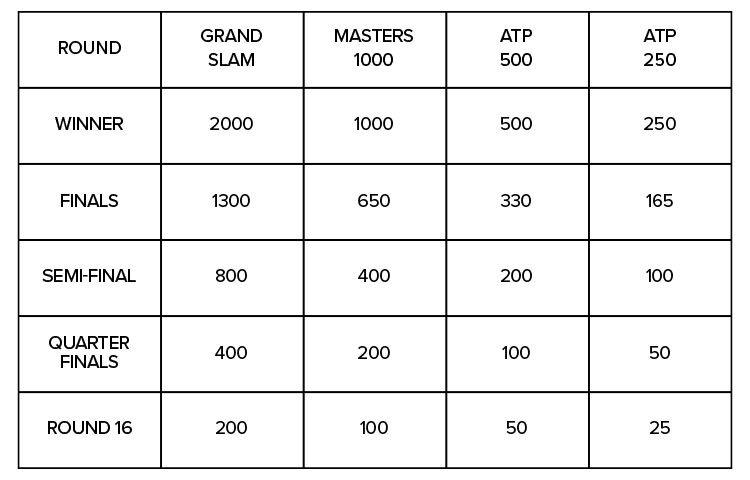
- Winner: 2000 points
- Runner-up: 1300 points
- Semi-finalist: 800 points
- Quarter-finalist: 400 points
Such a significant difference in points explains why one strong Grand Slam performance can "launch" a player from outside the top 100 directly into the upper ranks of world tennis.
ATP Masters 1000 – the elite series
Just below the Grand Slams are the Masters 1000 tournaments (Indian Wells, Miami, Madrid, Rome...). As the name suggests, the winner receives exactly 1000 points. These tournaments are mandatory for the highest-ranked players, and the competition is often just as strong as at the biggest events.
ATP 500 and ATP 250
These tournaments form the "lifeblood" of the tennis season. While the ATP 500 series offers significant points for breaking into the top ranks, ATP 250 tournaments are places where younger players build their careers or where stars return to form after injuries. Victories here bring 500 and 250 points respectively to the champion.
Table: overview of points by round
To better understand how rankings are built, let's take a look at the points distribution table for the most important categories:
ATP Finals: the crown of the season for the best eight
A special gem in ATP ranking points is the season-ending tournament (ATP Finals). Only the eight best tennis players of the calendar year qualify for it. The unique feature of this tournament is that points are accumulated match by match during the group stage:
- Each group-stage victory awards 200 points.
- A semi-final victory awards an additional 400 points.
- A final victory awards another 500 points.
- An undefeated champion can earn a maximum of 1500 points.
This is the only tournament where a loss does not mean elimination and where a player can become champion even after losing one match in the group stage.
ATP Live Ranking vs. Official Rankings
For statistics and betting enthusiasts, it is crucial to distinguish between the official ATP rankings (updated every Monday) and the so-called "Live Ranking."
The Live Ranking tracks points in real time. As soon as a player wins a first-round match at a tournament, the points for that round are virtually added to their total, while the points earned at that same tournament the previous year are simultaneously removed.
Following live rankings allows us to see:
- Who will become the new world No. 1 before the tournament ends.
- Which players are fighting to enter the Top 10 or Top 32 (important for tournament seeding).
- How much "pressure" is on a player defending a final appearance while currently struggling with form.
The impact of rankings on betting strategy
Why is all of this important? Because the numbers in the rankings often hide the real picture of a player's form. Here are several factors to consider:
"Race to Turin"
In the second half of the season, the focus shifts from the overall ATP rankings to the "Race" rankings (points earned only during the current year). Players close to eighth place become extremely motivated and often play more smaller tournaments (ATP 250 and ATP 500 events) to collect crucial points. Betting on such players can be profitable because their motivation is at its peak.
Ranking drops due to injuries
When a top player returns after a long absence, their ranking is low because their points have "expired." As a result, they are not seeded and can face the top seed as early as the first round. These are often matches where value can be found, because the "paper" ranking does not reflect the player's true quality.
Fatigue and scheduling decisions
Players who make deep runs at a Masters tournament in one week often "sacrifice" the ATP 250 event that immediately follows. The reason is simple: the effort required is not worth the relatively small number of points available, and the body needs recovery time before the next major objective.
Special categories: doubles rankings and challengers
Although singles players receive the most attention, ATP ranking points also apply to doubles competition and the Challenger Tour. Challengers are crucial for players ranked between 100th and 300th in the world. Winning a stronger Challenger event can bring between 75 and 175 points, which is often the difference between gaining direct entry into a Grand Slam main draw and having to play demanding qualifying rounds.
Conclusion: knowledge is an advantage
Tennis is a sport of ruthless mathematics. Every ace, every break and every set won ultimately turns into numbers that define far more than a single match. Understanding tennis ranking points by tournament gives you a broader perspective because you are not just watching a single match that you may be betting on live, but also understanding the context in which it is being played.
When you know how many points a player is defending, what their motivation is and how the ATP Tour hierarchy works, your analysis becomes much more precise. In a world where small details make all the difference, understanding the mathematics of tennis is your greatest advantage.

A born enthusiast. Looking forward to a new day and new opportunities to learn. Enjoying in conversations with other people and understanding their emotions, always ready to be a good listener. Able to display a whole lott of positive emotions and pass it to other people. Not having problems with talking in front of the group and keeping their attention. Careful with keeping promises and looking at life with internal locus of control.