

Crypto betting | What to check before your first deposit
Crypto betting is increasingly being mentioned as part of modern online sports betting, especially among users who already use digital currencies. However, it is important to clarify one basic thing immediately: crypto does not change the nature of betting itself. It does not change the odds, does not increase the chance of winning and does not remove the risk that every bet carries.
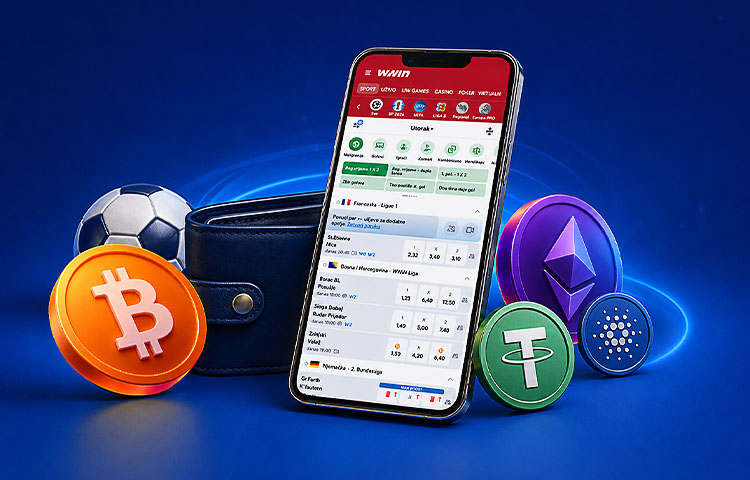
What changes is the method of deposit and withdrawal. Instead of a card, bank transfer, or another traditional payment method, the user uses cryptocurrency. This can be Bitcoin, Ethereum, USDT, USDC, or another digital currency supported by the platform.
Because of this, crypto betting should not be viewed as a shortcut, but as a technically different payment method. For users who understand crypto wallets, blockchain networks, and fees, this model can be practical. For beginners, the first step should not be making a deposit, but understanding the basic rules.
Crypto is not a new type of bet
With crypto betting, the betting slip looks the same as with traditional betting. The user selects a sports event, follows the odds, decides on the type of bet and determines the stake amount. The difference is that the funds are not deposited in a traditional currency, but in a digital asset.
This means that the sports betting aspect remains the same. Analysis of team form, injuries, statistics, schedules, and motivation still plays a key role. Cryptocurrency does not affect the outcome of a match nor provide any additional advantage in prediction.
That is why it is wrong to view crypto betting as a more advanced way to achieve winnings. It can only be more advanced in a technical sense, meaning in the way money is sent and withdrawn.
How crypto deposits work
A crypto deposit usually starts in the user’s wallet. This can be a mobile app, an online wallet, a desktop solution, or a hardware device. When the user wants to deposit funds, the platform generates an address to which the appropriate cryptocurrency should be sent.
Before sending, it is important to check three things: the currency, the network, and the address. If any of these elements is incorrect, the transaction may become problematic or permanently lost. Unlike bank transfers, blockchain transactions often cannot be reversed.
After sending, the transaction must receive confirmations on the network. Only once it is confirmed are the funds displayed on the user’s account. Withdrawals work similarly, but in the opposite direction: the user enters the address of their wallet, selects the amount and waits for the request to be processed.
Although crypto withdrawals can be faster than some traditional methods, this is not always guaranteed. The speed depends on the platform, security checks, network congestion, and withdrawal rules.
Currency, network and fee
One of the most common mistakes is the belief that it is enough to simply choose a cryptocurrency. In practice, the user must also know through which network the funds are being sent.
The same cryptocurrency can exist on multiple networks. If the platform supports one network, but the user sends funds through another, the transaction may not be properly recorded. That is why checking the network is just as important as checking the address.
Another important factor is the fees. They depend on the blockchain and the current network congestion. With smaller deposits, the fee can have a greater impact than the user expects. Before making a transaction, it is necessary to check how much is charged for sending and whether the platform has additional deposit or withdrawal fees.
Attention should also be paid to minimum amounts. If the user sends less than the allowed minimum, the funds may not appear on the account. That is why the terms should be read before sending, not only when a problem appears.
Bitcoin, Ethereum, or stablecoin
Bitcoin is the most well-known cryptocurrency and is often the first association with crypto betting. However, it is not always the most practical choice for smaller or faster transactions.
Ethereum is also widely used, but its fees can vary, especially when the network is congested. That is why the popularity of a currency does not automatically mean that it is the best choice for every deposit.
Stablecoins, such as USDT or USDC, are often more practical for users who want to reduce the risk of value fluctuations. Their price is tied to a traditional currency, most commonly the US dollar, so they are less exposed to sudden changes.
This is especially important in betting. If a user deposits a volatile cryptocurrency, its value may change while waiting for the outcome of the betting slip. With stablecoins, this additional risk is usually lower.
When crypto deposits can be practical
The most commonly mentioned advantage of crypto betting is speed. In certain cases, deposits and withdrawals can be faster than bank transfers or other traditional methods.
Another advantage is accessibility. Cryptocurrencies are not tied to a single bank or local payment system, so users who already have a crypto wallet can manage their funds more easily.
The third advantage is the transparency of the transaction itself. Blockchain allows verification of whether a deposit has been sent and confirmed. This does not mean that every platform is automatically reliable, but it does mean that the transaction has a visible digital trace.
However, these advantages should be viewed realistically. Speed does not always mean security, and technical transparency does not replace checking the platform’s terms and conditions.
The most common user mistakes
The biggest problems with crypto betting are often caused by carelessness. The first mistake is sending funds to the wrong address. With blockchain transactions, recovery is often not possible.
The second mistake is choosing the wrong network. This is especially important with stablecoins, because the same currency can be available on multiple networks.
The third mistake is ignoring fees. A user may plan one amount, only to realize that part of the funds has gone toward transaction costs.
The fourth mistake is not reading the platform rules. Before making a deposit, it is important to check limits, processing times, possible identity verification, and withdrawal rules.
The fifth mistake is mixing crypto investing and betting. Cryptocurrencies carry market risk, while betting carries outcome risk. When these two risks are combined, additional caution is required.
Crypto does not change the chances of winning
The payment method has no impact on the sports result. If you bet on a match, the outcome depends on the game, form, tactics, injuries, and other factors. Cryptocurrency does not change any of these elements.
That is why crypto betting should not be presented as a better way to predict betting slips. It only changes the technical part of the process. Everything else remains the same: odds should be understood, stakes should be controlled, and risk should be accepted as part of betting.
Budget, limits, and record keeping
Responsible betting is important in every form, but with crypto it carries additional weight. The user is not only facing the risk of the bet, but also the possible change in the value of the digital currency.
The first rule is to define a budget in advance. This should be an amount intended exclusively for entertainment. The second rule is not to increase stakes impulsively after a loss. The third is to keep records of deposits and withdrawals, especially when volatile cryptocurrencies are used.
Betting should be viewed exclusively as entertainment for adults, never as a way to earn money or as a financial plan.
Before making a deposit, check the basics
Before the first crypto deposit, it is necessary to check the currency, network, address, fee, minimum amount, and the platform rules. If any part of the process is unclear, it is better to stop than to send funds blindly.
With crypto, a small mistake can have major consequences. That is why education is more important than speed.
Crypto as a tool, not a shortcut
Crypto betting can be practical for users who already understand digital currencies and approach betting responsibly. However, it is not a guarantee of safer betting, bigger winnings, or better results. Crypto is only a tool, while the basic rules remain the same: play only if you are an adult, with a pre-defined budget, and without expecting betting to become a source of income.
In this context, platforms such as WWIN are part of a broader change in which online betting, digital payment methods, and the habits of modern users are becoming increasingly connected. For beginners, however, the most important first step is not making a deposit, but understanding the system, the risks, and the rules of responsible betting.

A born enthusiast. Looking forward to a new day and new opportunities to learn. Enjoying in conversations with other people and understanding their emotions, always ready to be a good listener. Able to display a whole lott of positive emotions and pass it to other people. Not having problems with talking in front of the group and keeping their attention. Careful with keeping promises and looking at life with internal locus of control.