

Card games for two | Rules, tactics, and best choices
Card games have been an endless source of fun, socializing, and serious intellectual competition for centuries. While some forms of entertainment, from poker and blackjack to slot games, are synonymous with excitement and casino atmosphere, there's a special charm to the games played face to face.
When you're alone with a friend, partner, or family member, an ordinary deck of cards becomes a gateway into a world of tactics, bluffing, and quick thinking. Card games for two demand a specific kind of focus; there's no room to hide behind a teammate or wait for someone else to make a bad move. Every card dealt and every discard directly shapes the outcome of the duel.
Whether you're looking for relaxed fun over coffee or a tense match where every card counts, knowing the right games can turn an ordinary afternoon into a top-tier competitive experience. In this guide, we'll explore the most popular and exciting games for two players, their rules, and the strategies that bring victory.
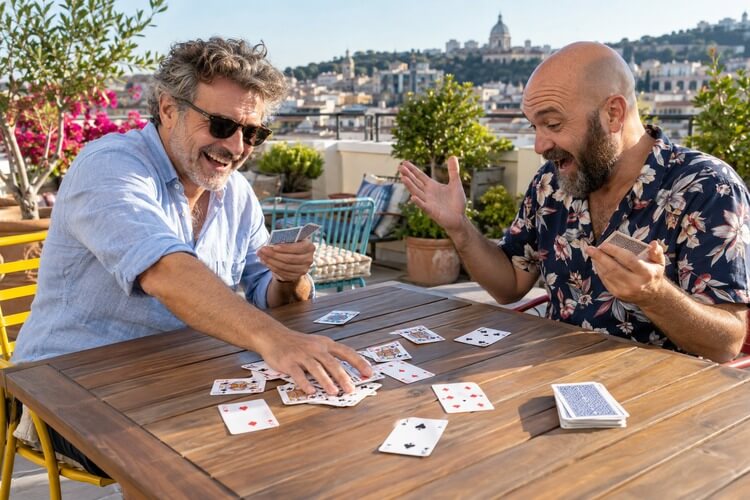
Basic rules and duel dynamics
Before we get into specific games, it's worth understanding what makes a good two-player game. Unlike group games where luck can be spread across several sides, in duels the math is clearer and the psychology more pronounced.
Most of these games use a standard 52-card deck, and success hinges on:
- Memory: keeping track of which cards have already been played.
- Risk assessment: knowing when to "close" the game and when to wait for a better card.
- Bluffing: making your opponent believe you hold a stronger or weaker hand than you actually do.
Rummy – the classic that never gets old
Rummy is probably the most popular card game in our region when it comes to head-to-head play. Although there are many variations, the basic goal stays the same: get rid of all the cards in your hand by forming meaningful sets.
Rules and objective
In the two-player version, two standard 52-card decks with jokers are usually used. Players are dealt 14 cards each (the first player gets 15). The goal is to form groups (three or four cards of the same value, e.g. three kings) or runs (three or more consecutive cards of the same suit, e.g. 5, 6, 7 of hearts).
Winning strategy
In one-on-one play, Rummy becomes a game of patience. It's crucial to watch what your opponent picks up from the discard pile. If your opponent keeps taking spades, it's clear which run they're building. Strategy generally splits into two approaches:
- Laying down early: playing groups as soon as they're formed to reduce the points left in your hand.
- Holding back: keeping cards in hand until the very end so your opponent can't use them to extend their own sets, leading to a sudden finish ("hand-rummy").
Tablić – a Balkan card-capturing game similar to Cassino
Tablić is our own local queen of card games. Although it's often learned in childhood, a high-level match between two experienced players is a real tactical battle.
How is it played?
The game uses 52 cards. The goal is to "capture" cards from the table whose sum matches the value of the card you play from your hand. Face cards have the following values: Jack (12), Queen (13), King (14), while the Ace can count as 1 or 11.
Scoring – where the difference is made
In Tablić, it's not just about capturing a lot of cards, but capturing the "valuable" ones.
- Small and big tables: the ten of diamonds (two points) and the two of clubs (one point) are key.
- Face cards and aces: each of these is worth one point.
- Most cards: whoever collects more than 26 cards gets an extra 3 points.
Tactical tip
Experienced players always hold on to the "small two" or the "ten of diamonds" for a moment when they're sure their opponent can't capture them. It's also crucial to keep count of the aces – if you know three aces are already out, your approach to the game changes significantly.
Schnapsen – an intense 20-card game
Schnapsen is highly popular in Central Europe and parts of Vojvodina. It's a fast, aggressive game played with just 20 cards (Ace through Ten in four suits).
Game dynamics
Players are dealt 5 cards each, and one card is turned up as trump. The game is unique in that points are collected during the hand itself (the goal is to reach 66 points). The moment you believe you have 66 points, you "close" the game.
Special combinations: "Twenty" and "Forty"
If you hold the king and queen of the same suit, that earns you 20 points (or 40 if it's the trump suit). In head-to-head play, Schnapsen is a game where mistakes are costly, since a wrong estimate or closing too early brings penalty points.
Mau-Mau – fun and fast-paced
If you're after something more dynamic and less math-heavy, Mau-Mau is a great choice. Although it looks simple, in a two-player match it becomes highly competitive because the effects of "special" cards keep coming back to the same player.
- Seven: forces the opponent to draw two cards. In a two-player game, this is a powerful tool for disrupting your opponent's strategy.
- Eight: skips the opponent's turn.
- Jack: changes the suit.
Strategy comes down to managing your "bad" cards and saving the ones that change the flow of the game for the very end, to keep your opponent from being able to finish.
Analysis and probability: the key to success in card games
Just like betting on sports such as basketball or handball, card games for two aren't just about luck. Successful players take an analytical approach:
- Tracking probability: if you're waiting for a specific card in Rummy, and you've already seen two copies of it discarded, your chances of getting it drop significantly. Adjusting your strategy on the fly is what separates the masters from the beginners.
- Psychological edge: in a two-player game, your only focus is one person. Watch their reactions – do they draw quickly? Do they hesitate? Nervousness when drawing a card often gives away a "bad hand."
- Managing resources: in games like Tablić, cards are your resources. Sometimes it's better to deliberately skip a smaller gain in order to capture the "table" in the next round.
Card games in an online environment
Today, you no longer need a physical deck of cards on hand. Platforms like WWIN let fans of games of chance and card games test their skills in a digital format. Online versions of these games often offer faster gameplay and the chance to play against different types of opponents, which is a great way to sharpen your tactics.
Betting on the outcomes of card games or playing versions against software (or a live dealer) requires the same discipline we mentioned when it comes to sports betting. Knowing the rules down to the smallest detail is a prerequisite, but emotional control is what brings profit in the long run.
Why two-player games are irreplaceable
Card games for two are more than just a hobby; they're a workout for the mind, a test of patience, and top-tier social interaction. Whether you choose the strategic depth of Rummy, the mathematical precision of Tablić, or the fast moves of Mau-Mau, every game is a new story.
Success in these games comes through experience. The more you play, the better you'll "read" your opponent and the easier it will be to make decisions under pressure. Cards are here to entertain us, but also to teach us how to be better strategists in everyday life.

A born enthusiast. Looking forward to a new day and new opportunities to learn. Enjoying in conversations with other people and understanding their emotions, always ready to be a good listener. Able to display a whole lott of positive emotions and pass it to other people. Not having problems with talking in front of the group and keeping their attention. Careful with keeping promises and looking at life with internal locus of control.